Bloomberg Space
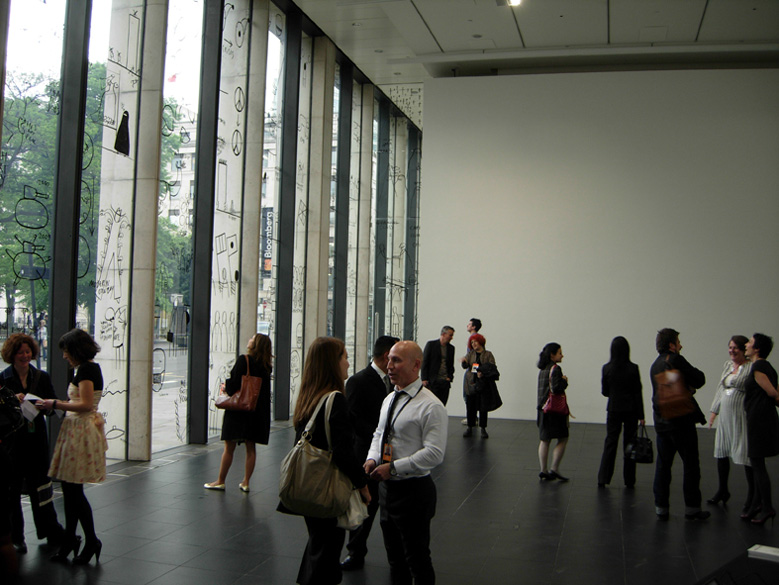
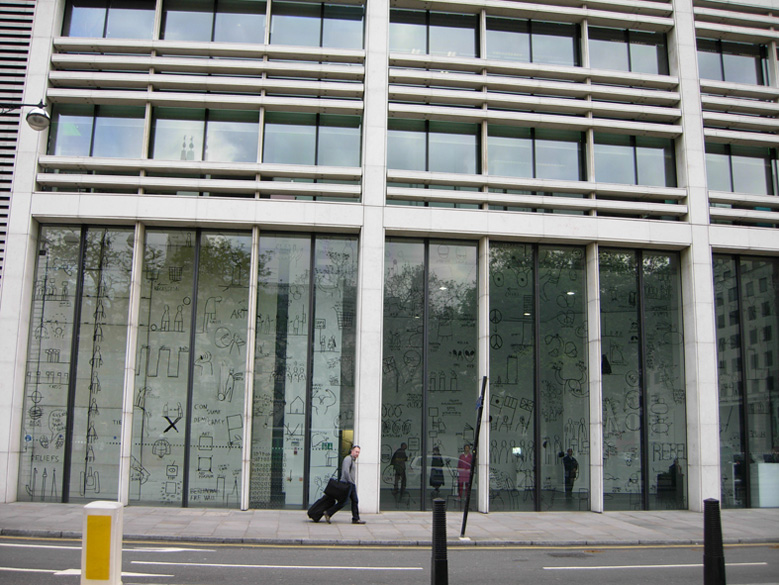
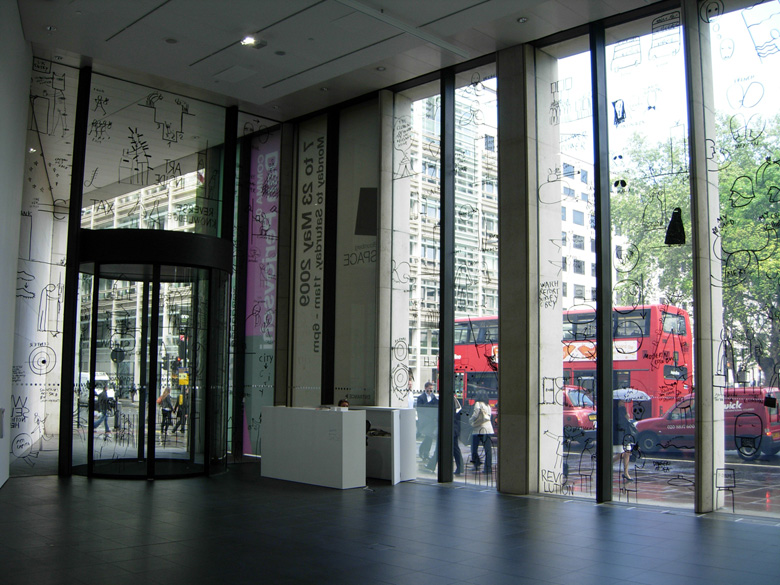
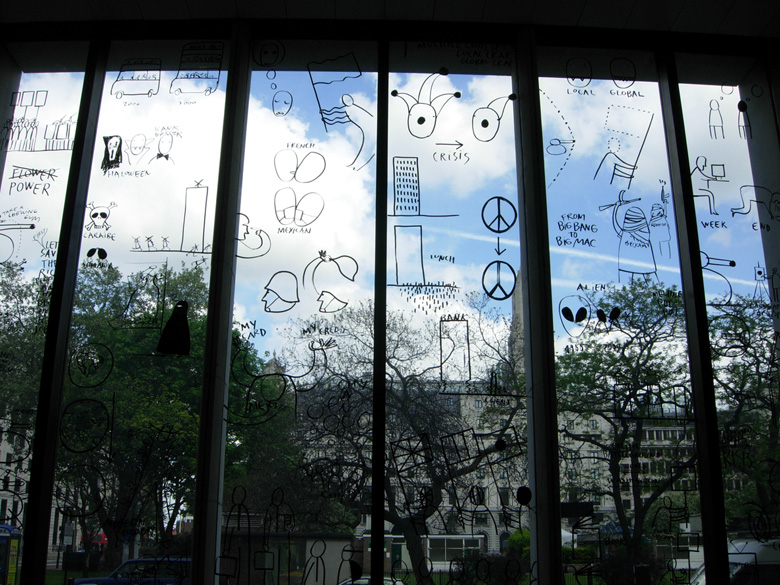
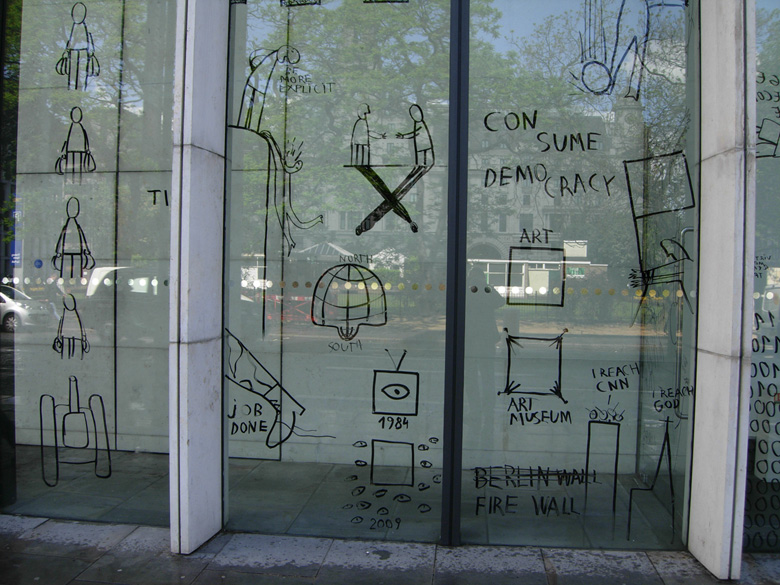
At Bloomberg Space, inspired by the thought of Bloomberg as a purveyor of information, and by the need for transparency in the transmission of information, he has been drawing on the glass windows. Some of his drawings in previous exhibitions have had a single life, while others have been allowed to develop over time. An initial drawing of an artist lying on the floor with a hammer and sickle stabbed in his back has a group of observers saying “Nice Show”, suggesting an ignorance of what the artist might actually have been living through. A later version, reflecting the disillusion of the more recent era, has the same stabbed artist confronted by a similar figure with a credit card in his back, and a caption that reads “We have a lot in common.”
Ironic and sceptical, Perjovschi’s perceptions are highly political and exceptionally well-informed. The ideas that lie behind the drawings, he explains, are collected from everyday experience, but particularly from newspapers, national and foreign. They come “from talks, sightseeing, rumours, newspaper articles, gossip, television, jokes, major stories, insignificant stories, global news, local events, everything.” He never stops working, drawing incessantly in a series of notebooks. Then, “out of two hundred drawings, twenty will make it to the wall.”
Perjovschi would probably prefer to be considered simply as an artist, but given the particular recent history of his country and his own involvement in the hard struggle to create a new cultural environment there, it is perhaps inevitable that he should often be perceived as a specifically Romanian artist, in whose work can be seen the tensions of the new post-Communist society created over the past two decades. Perjovschi can make fun of this perception, disliking the notion that a particular group of artists can be exoticised in this manner. He has a drawing of himself (he has a trademark moustache) with the legend “I am not exotic I am exhausted.” Yet he has in fact been tireless in campaigning on behalf of Romanian artists in the surprising environment in which they found themselves after 1989.
Excerpt from Richard Gott’s text “Dan Perjovschi at Bloomberg Space: the new work and the ideas behind the artist’s practice”